How to Take Deposits for Appointments (and When You Shouldn't)
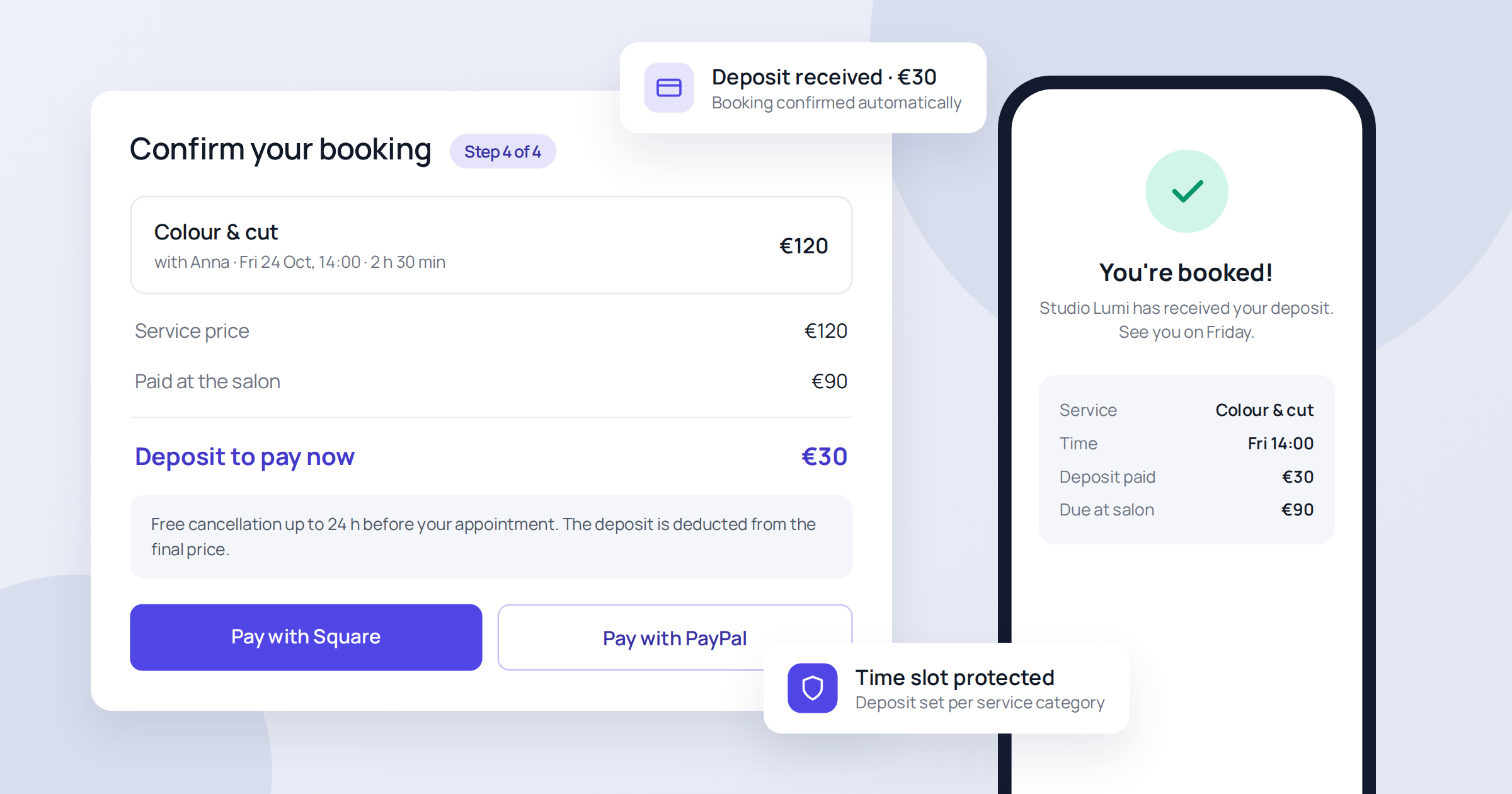
A booking deposit is one of the simplest ways to protect your time. A client who has already paid a small amount is much less likely to forget the appointment or skip it without telling you. Asking for money upfront also adds a step to booking, though, and if you use it in the wrong places it can put new clients off. This guide explains when a deposit makes sense, how much to ask for, how to write a cancellation policy clients will accept, and how to take deposits online without extra admin in 2026.
Deposit, full prepayment or nothing?
There are three common ways to handle payment for appointments:
- No upfront payment. The client pays after the service. Booking is as easy as possible, but a no-show costs the client nothing.
- A deposit. The client pays a fixed part of the price when booking and the rest on the day. It's a small commitment that still feels fair.
- Full prepayment. The client pays the whole price when booking. This works well for classes, workshops, fixed-price packages and services where the price is known exactly in advance.
Most appointment-based businesses do well with a mix: no payment for short, low-risk services, and a deposit or full prepayment for the appointments where a no-show would really hurt.
When a deposit makes sense
A deposit is worth asking for when a missed appointment is expensive or hard to fill. Typical examples:
- Long appointments. A two- or three-hour colour treatment, a long massage or a full set of extensions blocks a large part of the day.
- Services that need preparation. Special products, ordered materials, a booked room or equipment that has to be set up in advance.
- Peak times. Friday afternoons, Saturdays and the weeks before holidays, when you could easily have given the slot to someone else.
- First-time clients. New clients don't know you yet, so skipping a booking feels less awkward to them.
- Clients who have missed before. Asking a repeat no-show to pay a deposit is a fair, neutral way to keep booking them.
When you shouldn't ask for a deposit
A deposit isn't free. It adds a payment step, and some clients will leave the booking page rather than enter card details. Think twice before requiring one in these cases:
- Short, cheap services. For a quick trim or a 15-minute check-up, the extra step can cost you more bookings than it saves.
- Loyal regular clients. If someone has been coming for years and always turns up, a deposit can feel like a lack of trust.
- Last-minute bookings for today. Someone booking an hour ahead is very likely to come. Making it harder only slows them down.
- Services where the final price isn't known. If the price depends on what you find during the appointment, a fixed deposit is fine, but full prepayment isn't.
- When your no-show rate is already low. If reminders already keep your schedule full, a deposit may solve a problem you don't have.
How much should the deposit be?
There's no single right number, but a few rules of thumb help:
- Big enough to matter. The amount should be noticeable to the client. A token amount doesn't change behaviour.
- Small enough not to scare people off. Many businesses settle on roughly 20–50% of the service price, or a round fixed amount.
- Linked to your real loss. For a long, expensive service, a higher deposit is easy to justify. For a mid-length service, a smaller fixed amount is usually enough.
- Simple. A round number such as 10, 20 or 50 in your currency is easier to explain than a precise percentage.
For example, a salon might ask for no deposit on haircuts, a small fixed deposit on colour services and a larger one on bridal packages. Clients see that the rule depends on the service, not on them.
Make booking easier for your clients
Let clients book online 24/7, send automatic reminders and cut no-shows. Set up your booking page in minutes.
No credit card required
Write a cancellation policy clients will accept
A deposit only works together with a clear policy. Clients need to know, before they pay, what happens if they cancel. A good policy answers four questions:
- How much notice is needed? For example, 24 or 48 hours before the appointment.
- What happens to the deposit with enough notice? Refunded, or moved to a new appointment.
- What happens with late cancellations and no-shows? Usually the deposit is kept.
- What about real emergencies? Say that you handle them case by case. It costs you little and builds goodwill.
Here is an example you can adapt: "A deposit is required to book this service. If you cancel or reschedule at least 24 hours before your appointment, we'll move your deposit to the new time or refund it. Late cancellations and missed appointments forfeit the deposit. The deposit is deducted from the final price."
Show the policy on your booking page and repeat it in your confirmation and reminder messages. Rules about deposits, refunds and consumer rights differ between countries, so check what applies where you work before you publish your policy.
How to take deposits online with timedule
Taking deposits by bank transfer or over the phone is slow and easy to get wrong. With timedule's online booking, clients pay when they book, and the appointment and payment arrive together.
- Connect a payment provider. In the dashboard, open Settings and find Online payment. Connect PayPal or Square with the details from your account there.
- Choose full payment or a deposit. Decide whether clients pay the full price when booking or a fixed deposit.
- Set a default deposit. This amount is used for every service unless you set something else.
- Customise deposits per service category. Give long or expensive service categories a higher deposit and keep it lower elsewhere. If a client books several services at once, the highest deposit among them applies.
- Update your messages. Add your cancellation policy to the booking page, confirmation and reminder texts.
Payments go straight to your own PayPal or Square account, and timedule takes no commission on your bookings. The payment provider charges its own processing fees, so check their current rates and factor them into your deposit amount. Refunds are made from your PayPal or Square account.
Make deposits feel fair to clients
How you present a deposit matters as much as the amount. A few habits keep it friendly:
- Explain why. One sentence is enough: "Because this treatment takes three hours, we ask for a deposit to hold your time."
- Always deduct it from the price. A deposit should be an advance payment, not an extra fee.
- Be consistent. Apply the policy the same way to everyone, and use your discretion openly for real emergencies.
- Make rescheduling easy. Most clients who cancel early just want a different time. Moving their deposit keeps both the client and the income.
Conclusion: use deposits where they count
Deposits work best as a targeted tool, not a blanket rule. Ask for them on long, expensive or high-demand appointments, keep booking easy for short services and loyal clients, and back everything with a short, fair cancellation policy. Combined with automatic reminders, this keeps your schedule full without making booking harder than it needs to be.
If you'd like to try it, sign up for timedule, connect PayPal or Square, and set deposits only for the services that need them.
Ready to dive in?
Start your free trial today.
Try our online booking software, and see how easy it is to manage your appointments.